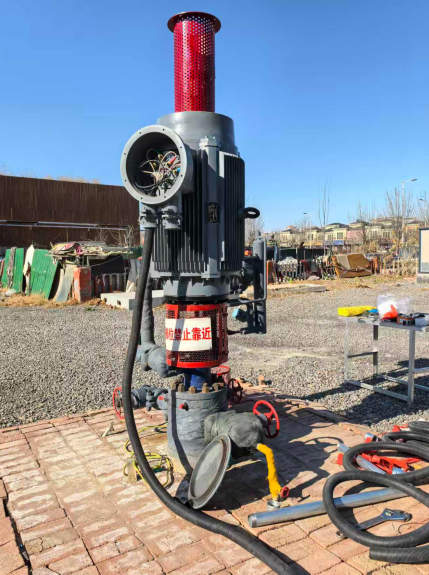
Question 1: Severe running fluctuations, resulting in a shortened lifespan of the accompanying plunger pump
Reason: The distance between the stator and rotor magnetic fields deviates by 10 mm from the optimal value, or there is an issue with the magnetic levitation positioning function. This causes the rotor to operate off-center, leading to increased wear and resulting in vibration.
Action: After shutting down the machine, check the distance between the stator and rotor magnetic fields and adjust it to the standard value of 10 mm. Inspect the friction pair formed by the rotor assembly and the stator’s internal support guide sleeves to ensure that the stator generates a uniform magnetic pulling force. This will guarantee that the rotor operates in the center without contact wear. If any impurities adhere to the magnets, use specialized tools to clean them and verify the compatibility with the magnetic levitation principle, thereby restoring the machine to a wear-free operating state.
Question 2: Sealing failure, allowing well fluid to penetrate into the motor
Reason: Aging of the sliding seal structure in the ring-type cascade control system, or reduced sealing performance due to harsh conditions at high altitudes, resulting in a lifespan that is 2-3 times longer than normal.
Solution: Replace the sliding seal components of the ring series regulation system to ensure tight sealing. Check the elasticity of the PEEK material in the breathing structure to confirm that the automatic pressure balancing function is working properly, thereby preventing internal pressure fluctuations from damaging the seal. After the operation, clean any impurities from the sealing surface to avoid corrosion from acids, alkalis, or salts, which could affect the sealing performance.
Question 3: Insufficient thrust during deep well operations, resulting in decreased drainage efficiency
Reason: The high-temperature performance of the mover magnet steel deteriorates, or magnets suitable for radial magnetization at 180°C were not used. As a result, the thrust at the same size does not meet the standard.
Solution: Replace the radial magnetizing magnets with those capable of operating at high temperatures of 180°C, ensuring that their performance is suitable for underground environments with temperatures ranging from 60 to 120°C. Check the firmness of the magnet installation to prevent displacement due to vibrations, which could affect thrust output. Adjust the motor specifications based on the well depth, selecting models with a rated thrust within the range of 25KN to 60KN.
Question 4: Motor Overheating Fault
Reason: The underground temperature exceeds the suitable range of 60–120°C, or the liquid flow cooling method is blocked.
Handle : Check the underground temperature conditions. If it exceeds the acceptable range, cooling measures must be taken. Inspect the motor’s oil immersion status to ensure sufficient and smooth flow of the cooling medium. Remove impurities such as sand particles and wax deposits from the oil to prevent blockages in the cooling channels.

Go Top

 Hotline:
057983718080
Hotline:
057983718080
 Scan
Scan



 Location: